

|
Rogers Unveils NHL Programming Strategy
– More games, more choice with upwards of 500 games across 13 networks –
– Up to 7 nationally-televised Hockey Night in Canada games on Saturdays –
– New national night: Sunday on City now appointment viewing with “Hometown Hockey” –
TORONTO (February 4, 2014) With eight months to go until the puck drops on the 2014-15 NHL season, Rogers today unveiled its high-level NHL programming strategy which will see the company deliver more than 500 regular season games across 13 networks, up to 7 games every Saturday night, expanded NHL content on 7 platforms, exclusive windows for national broadcasts, “Hometown Hockey” every Sunday hosted from communities across Canada, and every game of the NHL Playoffs and Stanley Cup Final.
 The announcement was made by Scott Moore, President of Sportsnet and NHL, Rogers Media, at the Rogers NHL Upfront at Mattamy Athletic Centre in Toronto. In November 2013, Rogers Communications secured a 12-year deal with the NHL for exclusive national broadcast and multimedia rights in Canada, beginning with the 2014-15 season.
“We are working together with the NHL on a strategic game schedule, which allows us to deliver the games that matter most to Canadians. We are going where the fans are,” said Moore. “Our vision is to transform the fan experience. There will be two conventional networks to deliver increased game coverage on Saturday nights, we have created a new national night for hockey on Sundays, we will be in hockey communities across the country every week, and we are leveraging all the Rogers networks and platforms to deliver expanded NHL content. There will be more games, more content, and more choice than ever before.”
Rogers’s NHL programming strategy for the 2014-15 season
* See “By The Numbers” addendum
* Additional details will be announced over the coming weeks and months
Saturdays – Hockey Night in Canada
· More than 130 regular season games airing nationally on Saturday nights
· Up to 7 games each Saturday, airing on CBC, City, Sportsnet, Sportsnet ONE, Sportsnet 360, and FX Canada:
o 7 p.m. ET: 3 – 5 games
o 10 p.m. ET: 1 – 2 games
o Tripleheaders on occasion
· More hockey on over-the-air television on Saturdays than ever before with CBC and City
· Exclusive night; no other NHL games airing on Saturday night
· A total of 13 networks will be airing hockey games in English and French on Saturdays:
o CBC, City, Sportsnet (East, Ontario, West, Pacific), Sportsnet ONE, Sportsnet 360, Sportsnet Radio Network, FX Canada, TVA, TVA Sports, TVA Sports 2
Sundays – Hometown Hockey
· Nationally-televised game every Sunday at 7 p.m. ET on City (including half-hour pre-game), marking a new night for hockey in Canada
o Games to feature a Canadian team
o Doubleheaders on occasion
· Every Sunday broadcast will be “Hometown Hockey”. Each game broadcast will be hosted from a different community rink across Canada, and will feature local NHL player profiles, grassroots stories told by our hockey broadcast team, and local entertainment features
· Additional match-ups to air on Sundays on Sportsnet and Sportsnet ONE
· Exclusive window; no other NHL games airing in that window
Wednesdays – NHL on Sportsnet
· Nationally-televised games every Wednesday night on Sportsnet
o Games to feature superstar match-ups, with emphasis on storytelling
o Doubleheaders on occasion
· Complemented by US vs. US match-up on Sportsnet ONE
· Exclusive window; no other NHL games airing during Sportsnet’s live game coverage
More Game Broadcasts
· More than 100 US vs. US match-ups to air nationally on Sportsnet 360 and Sportsnet ONE
o Regular Thursday night home position on Sportsnet 360
· Rogers to air all 82 regular season games for Vancouver Canucks, Calgary Flames, and Edmonton Oilers
o Includes regional broadcast rights
· Rogers to air minimum of 53 Toronto Maple Leafs games
o 40 national; minimum of 13 regional
Specials, Features, Storytelling, and News
· Seven platforms to deliver Rogers NHL content: TV, Digital, Radio, Publishing, Wireless, Cable, Social (additional details to come)
· Expanded pre-game every Saturday and Sunday on Sportsnet, beginning at 5 p.m. ET
· Sportsnet to showcase the NHL every night of the week, with live games, Hockey Central, and Connected
o Hockey Central to air every night; expanded to one hour
o Hockey Central at Noon continues on Sportsnet Radio Network and simulcast on TV
· 50 features to be produced, profiling the NHL’s top stars
· Hundreds of grassroots and community features to air during Hometown Hockey
About Rogers
Rogers is a leading diversified Canadian communications and media company. We are Canada’s largest provider of wireless voice and data communications services and one of Canada’s leading providers of cable television, high-speed Internet and telephony services. Through Rogers Media we are engaged in radio and television broadcasting, televised shopping, magazines and trade publications, and sports entertainment. We are publicly traded on the Toronto Stock Exchange (TSX: RCI.A and RCI.B) and on the New York Stock Exchange (NYSE: RCI).
* Information Courtesy of National Hockey League – Press Release
|
Rogers NHL Hockey Television Game Plan
Do Face-off Wins = Wins!

Face-offs are a very important part of a NHL hockey game. With an average of 60 face-offs per game, winning a faceoff can be very important. When a team wins a face-off, the team gains five extra seconds of puck possession on average. The team may also gain a quality scoring chance by winning the face-off. The question is, how does winning a face-off correlate with the team winning the hockey game? I feel it is very important for a team to win face-offs to be successful. It is like winning one-on-one battles in the corners, usually the winning team wins more during the game. Puck possession is important, and the more face-offs a team wins the more games they win. Based on this seasons National Hockey League face-off statistics, winning face-offs is important to a team’s success, but not critical.
The best NHL team this season on face-offs is Los Angeles Kings who win 53.2% of the face-offs that they take. The worst is the Winnipeg Jets at 46.00%. The league spread is 4.71%. That is not a huge difference, but enough to make a difference.
Although winning face-offs does not guarantee wins, it sure does help. The top ten teams based on record in the NHL average 50.9% of face-off wins. The second ten teams based on record average a little less at 50.29%. The worst ten teams based on record only win 48.8% of their face-offs. This is where it really comes into play. Based on the stats, winning face-offs does not help you become an elite team, but being good at face-offs will help move you up in the standings.
The Anaheim Ducks have the best record in the NHL and currently rank 20th in face-offs with 49.1%. The worst team in the NHL is the Buffalo Sabres and to go along with the worst record is the second worst face-off percentage in the league at 47.2%.
Winning face-offs will not guarantee wins, but they sure will help you move up into a playoff spot. NHL teams that are currently in a playoff spot win 50.71% of their draws and teams currently out of a playoff spot win 49.91%.
Winning draws is not as critical as I once thought, but it sure does not hurt. Ask any coach in the league, when it comes to big draws in the playoffs, you sure want to be on the winning side of them.
Back-up Goalies Playing Like Starters

The back-up goalies in the NHL this year have forgotten that they are back-ups. The statistics speak for themselves. Many back-ups have outplayed their starting teammate between the pipes. This is great news for many NHL coaches, but has also started some goaltender controversies. The following are the statistics for the top ten back-up goalies.
San Jose – Alex Stalock – 14 GP – 7-4-0 – 1.69 GAA – .939 SV%
Los Angeles – Martin Jones – 13 GP – 8-4-0 – 1.71 GAA – .940 SV%
New York Rangers- Cam Talbot – 16 GP – 10-4-0 – 1.78 GAA – .935 SV%
Anaheim – Fredrik Anderson – 17 GP – 14-2-0 – 1.94 GAA – .931 SV%
Montreal – Peter Budaj – 14 GP – 6-4-1 – 1.97 GAA – .926 SV%
Phoenix – Thomas Greiss – 14 GP – 7-4-1 – 2.09 GAA – .932 SV%

Carolina – Anton Khudobin – 17 GP – 12-4-0 – 2.16 GAA – .927 SV%
Winnipeg – Al Montoya – 16 GP – 9-4-1 – 2.22 GAA – .925 SV%
Vancouver – Eddie Lack – 21 GP – 8-7-3 – 2.28 GAA – .919 SV%
Boston – Chad Johnson – 15 GP – 9-3-0 – 2.30 GAA – .919 SV%
Having a quality two-man goaltending team is a great problem for teams to have. Players tend to play better if another quality guy is pushing him. These statistics also make some of these high dollar, long-term contracts signed by goalies very questionable. Do owners have to sign long-term deals for goalies, or is a three-year bridge contract make more sense? Having a great back-up can also be very important heading into the playoffs. Is two man goalie tandems the wave of the future?
Franchise Cornerstones Sign Extensions with Sharks
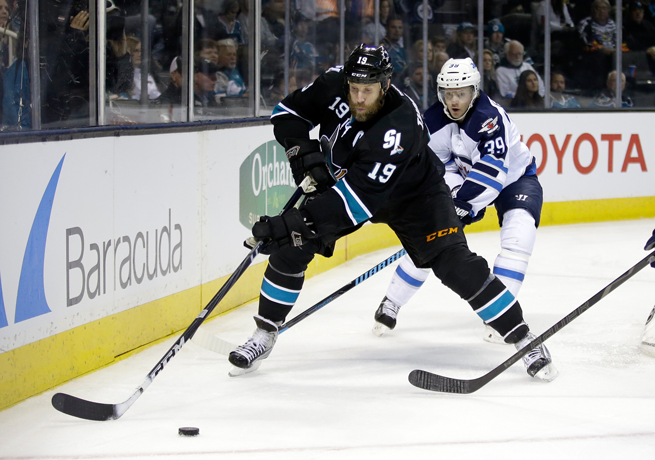
San Jose Sharks forwards Joe Thornton and Patrick Marleau will continue their illustrious careers in teal after each signing three-year extensions to remain with the team. Both players will remain key cogs to the team after being the franchise’s cornerstone players for the better part of the last nine seasons.
What do these deals mean for the Sharks moving forward? A few things to keep in mind.
It would appear that both the length and terms of the deals benefitted the Sharks organization as a team.
Thornton’s deal has an annual value of 6.75 million dollars. Marleau’s contract is worth 6.66 million dollars per year. Both deals have a no-movement clause.
Sharks general manager Doug Wilson stated that both players signed cap-friendly deals that will allow the Sharks to build the team around them and have continued success.
“I cannot complement these players enough,” Wilson said in an article on NHL.com. “We really appreciate what they’ve done here with these contracts, and they’ve done it several times… It says a lot about both of them as people and teammates.”
Considering the short supply of players at Thornton and Marleau’s levels that reach free agency, there was a very real possibility that another team could have outbid the Sharks.
Marleau confirmed before the deal that “there’s probably a good chance” he would have signed with another team if Thornton hadn’t agreed to stay with San Jose. Thornton reciprocated that statement in a later interview on sjsharks.com.
[pb_vidembed title=”” caption=”” url=”http://www.youtube.com/watch?v=C3fg9QmqOgc” type=”yt” w=”480″ h=”385″]
This past summer, San Jose signed Joe Pavelski and Logan Couture to matching five-year contracts.
The thought at the time was that those deals cemented them as the eventual predecessors to take the leadership positions after Thornton and Marleau. Their contracts will kick in after the season and hold hefty raises for each player and deservedly so.
However with Thornton and Marleau sticking around it’s less pressure on all four players in the leadership group. The wider age range of these star players means there’s a broader spectrum of viewpoints and opinions which in the Sharks case is probably a good thing.
Another point to be made for both Thornton and Marleau is the level of play considering their age. Each player is 34 years old but neither has shown signs of serious deterioration in play.
Thornton is near the top of the league in assists with 48 and is tenth in points with 56. Marleau earned a spot on Team Canada for the second time in his career after posting 49 points and 22 goals so far this season.
Neither one has proven to have much of an injury history (knock on wood). Thornton has missed a grand total of just six games since the 2005 lockout and two of those games were due to suspensions.
Marleau hasn’t missed any more than six games in a season in that same time period.
The fates of both Marleau and Thornton have been tied for some time now.
Thornton was taken with the first overall pick in the 1997 draft by the Boston Bruins. Marleau was taken with the following pick.
Once Thornton was traded to the Sharks in the 2005-06 season, he and Marleau have become the most identifiable scapegoats for not bringing a Stanley Cup to San Jose.
It would seem that winning a Stanley Cup in San Jose was one of the key factors in both players re-signing.
“We wanted to stay here together and sign together,” Thornton said in an article on NHL.com. “It’s important that we both stay. We both feel like we have a shot to win every year, and I think that’s the most important thing. We both really believe in this group of guys, and we want to stay around to see us win a Stanley Cup.”
That has to be a welcome sentiment to Sharks fans as the possibility was starting to grow that one of or both of the players would be leaving via free agency after the season.